Disability Inclusive Children’s Books
Many research studies have demonstrated the importance of picture books, read-alouds, and literature for young children in increasing their understanding of social issues, diverse perspectives, and different cultures. Using children’s books in the classroom, both fiction and nonfiction, can help students make real-world connections and broaden their perspectives, especially when incorporating literature by and centering people who have too frequently been underrepresented in educational literature because of their race, gender, sexual orientation, neurodiversity, or disability.
When students engage in a classroom discussion about the inclusive books they read, they can actively consider alternative perspectives. When it comes to kids' books that center on disability, there is a growing number of picture books, graphic novels, and early readers that provide educators with strength-based representations of people with disabilities. However, disabled children are still underrepresented in literature today. While approximately 26% of Americans are disabled, a character with disabilities is only found as the main character in about 3% of books. Additionally, finding strength-based representation is important, as studies have shown that children’s literature can significantly influence children’s attitudes toward stereotypes and their overall mental health, both for students with and without learning disabilities, underscoring its pivotal role in the classroom and beyond.
Why disability representation in children’s literature is essential in the classroom
The United States federal government defines people with disabilities as “someone who has a physical or mental impairment that substantially limits one or more major life activities.” The definition is broad enough to encompass many different types of disabilities, including intellectual disabilities, physical disabilities, and developmental disabilities. Ableism is discrimination against people with disabilities that occurs when stereotypes, biases, and myths about disability result in inequitable treatment. Often rooted in the idea of a “perfect” body, ableism contributes to limiting structures and viewpoints imposed by society on people with disabilities. Ableist attitudes can impact interactions in the classroom and beyond for both typically-developing children and students with disabilities. However, studies have shown that children’s literature can be a powerful tool in changing students’ perceptions of disabilities, better shaping their understanding of disability, and challenging societal stereotypes. Children’s literature about people with disabilities can support students with learning disabilities, helping them see themselves as actors with choice and a growth mindset.
According to the United States Department of Education, during the 2022-2023 school year, 15% of schoolchildren aged 3-21 received special education services in public schools, equivalent to 7.5 million children. In New York City alone, 18% of all public school students receive special education services. With such a significant portion of the student population receiving special education services, there is a need for representation of people with disabilities in literature beginning in elementary school and continuing in middle school, high school, and beyond.
What is the strength-based representation of people with disabilities in children’s books?
Books are powerful tools to shape understanding of the world, societal structures, and the lives of individuals. Reading can increase empathy, strengthen awareness, and recognition of experiences both similar and unlike our own. To build confidence and encourage a growth mindset when overcoming challenges, it is essential that students see themselves represented in the literature they read. This is especially important when seeking books about people with disabilities, since there has been a historically low amount of representation—especially strength-based representation. A strength-based representation of people with disabilities emphasizes the characters' abilities and strengths in the narrative. In these books, characters with disabilities are self-aware, making choices and taking action to further the narrative, and are presented with opportunities to grow and develop as people. Strength-based representation is important, both for typically-developing students to see people with disabilities as having agency, strength, and ability, and for students with disabilities to see themselves powerfully represented. Some teachers may specifically seek out “heartwarming” stories about disability, but children learn better when they have confidence and trust in their abilities, which is why strength-based representation is so important.
Classroom discussion of literature with representation of people with disabilities
Teachers should incorporate literature that portrays a wide range of disabilities and disability experience, including those from the thirteen categories recognized by the Individuals with Disabilities Act (IDEA):
Specific learning disability (such as dyslexia (reading disability), dyscalculia, or dysgraphia (math difficulties))
Speech or language impairment (such as a lisp or a stutter)
Other health impairment (such as attention-deficit/hyperactivity disorder (ADHD), Tourette syndrome, or epilepsy)
Autism Spectrum Disorder
Intellectual disability (such as Down Syndrome)
Emotional disturbance (such as depression or bipolar disorder)
Developmental delay
Multiple disabilities
Hearing impairment, including deafness
Visual impairment, including blindness
Traumatic brain injury
After a read-aloud, teachers should guide students in a discussion of what they have just read to increase understanding and make connections to themselves and the real world. In general education classrooms, teachers should encourage all students to participate in discussions. Some topics for discussion can include:
The definition of disability present in the narrative
The different ways a character’s disability affects their relationships with family, friends, school, and the wider world
How the characters with disabilities are treated in the narrative
Challenges that the characters face
It is important that students understand that disability is not a static, general definition; rather, each individual’s experience is unique and continuous. Additionally, students should recognize that disability is a part of a person’s experience of the world—it is a part of a set of complex, unique characteristics that make up an individual. Teachers can encourage students to make connections to their own lives, seeing aspects of the characters that are similar to them.
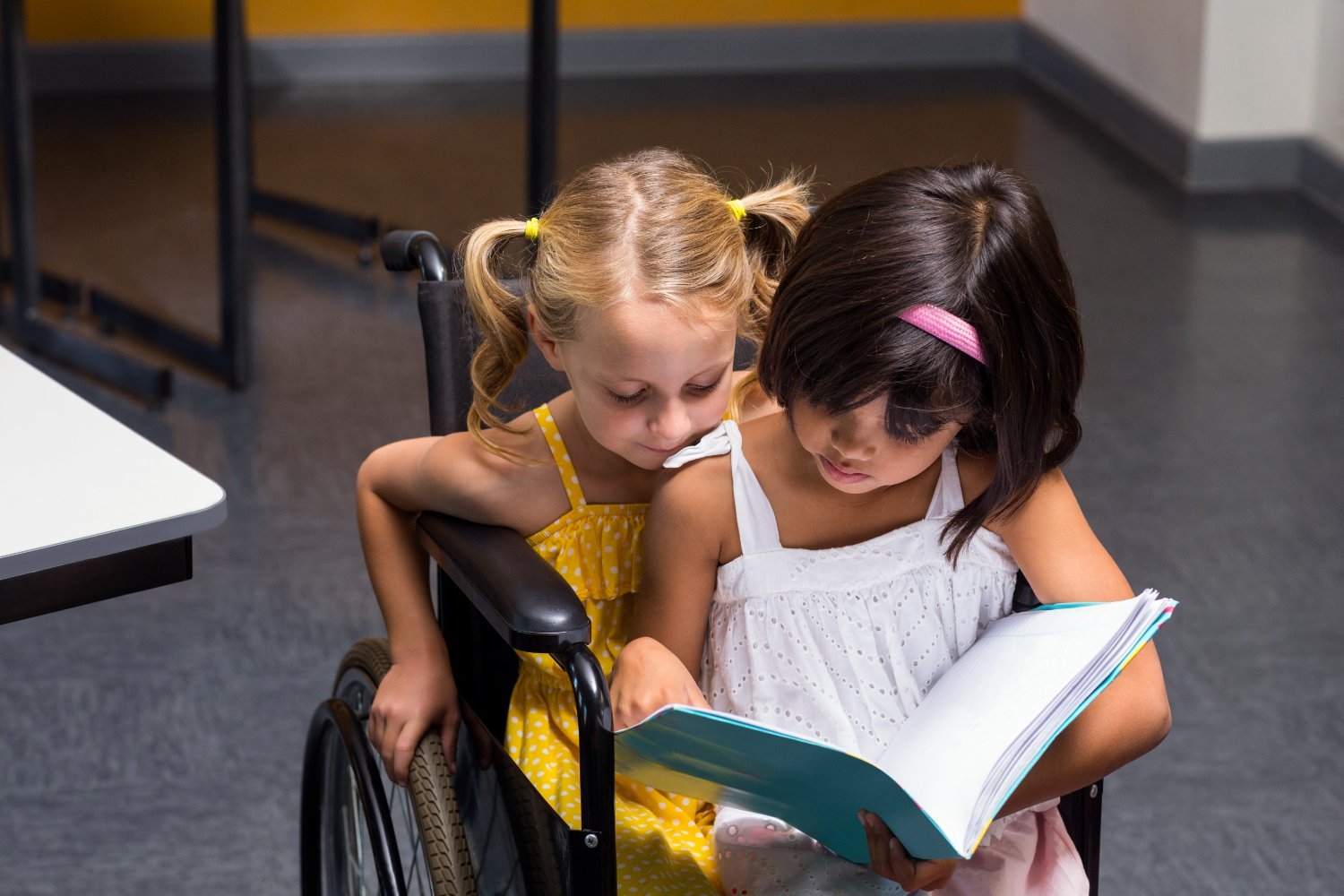
What are the best kids’ books for young readers that demonstrate strength-based representation of disability?
Disability representation is essential for raising awareness and understanding among students inside and outside the classroom, and teachers should begin integrating strength-based disability representation in children's literature in preschool and continue disability education through middle school and high school.
Below is a short booklist of literature with disability representation that can be integrated into the classroom.
All My Stripes: A Story for Children with Autism
By Shaina Rudolph and Danielle Royer
All My Stripes is the story of a young boy zebra named Zane, who has been diagnosed with autism. Zane’s mother helps him see that every person has unique qualities and that being neurodivergent and autistic is just one aspect of his identity, among many strengths such as kindness, honesty, and curiosity. This picture book is good for students in grades K-2.
All the Way to the Top: How One Girl’s Fight for Americans with Disabilities Changed Everything
By Annette Bay Pimentel
All the Way to the Top tells the true story of disability rights activist Jennifer Keelan-Chaffins and her determination to improve accessibility and visibility for people with disabilities. The book follows Keelan-Chaffins, who was born with cerebral palsy, as she participates in the Capital Crawl, a crucial rally to push for the passage of the Americans with Disabilities Act. This children’s picture book is good for students in grades K-3.
Benji, the Bad Day, and Me
By Sall J. Pia
Illustrator: Ken Min
This story follows two young siblings with different needs and neurodivergencies, exploring the idea that, even on bad days, your family is always there for you.
Grades Pre-K-K.
The Black Book of Colors
By Menena Cottin
Illustrator: Rosana Faria
The Black Book of Colors invites readers to imagine what it might be like to be blind. With all-black illustrations, raised lines, and braille text, The Black Book of Colors provides a multisensory reading experience. The book ends with a full Braille alphabet so that readers can learn more.
Grades Pre-K-2
Emmanuel’s Dream: The True Story of Emmanuel Ofosu Yeboah
By Laurie Ann Thompson
Illustrator: Sean Qualls
Emmanuel’s Dream tells the true story of Emmanuel Ofosu Yeboah. Born in Ghana with one deformed leg, Emmanuel pursued an education and helped support his family, eventually becoming a world-renowned cyclist and disability rights activist. This book is good for students in grades K-3 and for middle-grade students.
The Deaf Musicians
By Pete Seegar and Paul DuBois Jacobs
When jazz musician Lee loses his hearing, his bandmates ask him to leave their group. At the sign language class, Lee meets Max, who is also a musician, a saxophone player. When they are riding the subway home together, they form a new band. The Deaf Musician is a Schneider Family Book Award winner for students aged K-3.
El Deafo
By Cece Bell
El Deafo is the story of a young deaf girl, Cece, who is just starting at a new school. Unlike at her old school, where all of the students were deaf, Cece feels different at her new school, particularly with her hearing aid strapped to her chest. When Cece discovers that the hearing aid lets her hear the teacher everywhere (the classroom, the hallway, and even the bathroom), she realizes she may have a superpower. But being a superhero is just another way of feeling different when all Cece really wants is a true friend.
Grades 4-7.
Fighting for Yes!: The story of disability rights activist Judith Heumann
By Maryann Cocca-Leffler
This story, centered on disability pride, follows activist Judith Heumann as she fights for disability rights in the 1970s. Thanks to the work of Heumann and her community, Section 504 was enacted, paving the way for the Americans with Disabilities Act.
Grades 1-4.
Frida Kahlo: Little People, Big Dreams
By Isabel Sanchez Vegara
Illustrator: Fan Eng Gee
Translated by Emma Martinez
This picture book introduces the life of the Mexican artist Frida Kahlo, describing how her disability shaped her life and influenced her art.
Grades K-3.
The Girl Who Thought in Pictures: The Story of Dr. Temple Grandin
By Julia Finley Mosca and David Rieley
The Girl Who Thought in Pictures tells the true-life story of Temple Grandin, a scientist diagnosed with autism as a little girl. The picture book follows her journey of connecting with animals as a child and a young adult, and how her unique perspective enabled her to become one of the greatest voices in modern science.
Grades K-3.
I Talk Like a River
By Jordan Scott and Sydney Smith
I Talk Like a River is the story of a young boy who had a “bad speech day” at school. When he gets home, his father helps him to reframe his experience with his stutter.
Grades K-3.
Just Ask: Be Different, Be Brave, Be You
By Sonia Sotomayor and Rafael López
In this picture book, Sonia and her friends work together to plant a garden while sharing how each contributes to the community in their own unique ways.
Grades K-3.
My Three Best Friends and Me, Zulay
By Cari Best and Vanessa Brantley-Newton
This picture book follows Zulay and her three best friends, all first graders in the same class. During Field Day, Zulay decides she wants to run a race. Though Zulay is blind, with the help of a special aide, she runs the race while her friends cheer her on.
Grades K-3.
Not So Different: What You Really Want to Ask About Having a Disability
By Shane Burcaw and Matt Carr
Shane Burcaw answers common questions children ask about his disability in his picture book, Not So Different. He explains the aides that help him do his favorite things—many of which are the same as anyone else, such as eating pizza, playing sports, and playing video games.
Grades K-3.
Out of My Mind
By Sharon M. Draper
Out of My Mind is a chapter book for middle school students told in first person by Melody Brooks, an eleven-year-old with cerebral palsy. Because of the cerebral palsy, Melody cannot speak or write, but she is very bright, though she is frustrated by her school’s inability to see her as a fully capable student. The story follows her experience in elementary school as she joins the general education classroom and the trivia team.
Grades 4-7
Rescue and Jessica: A Life-Changing Friendship
By Jessica Kensky, Patrick Downes, and Scott Magoon
Rescue and Jessica is a story told from the perspective of a service dog paired with a little girl who lost her legs. The dog, Rescue, worries that he will not live up to the job of being her service animal.
Grades K-3.
Sam’s Super Seats
By Keah Brown
Illustrator: Sharee Miller
Sam is a young girl with cerebral palsy who loves learning, her friends, and herself. She is aware of the incredible importance of taking care of yourself and getting enough rest, and loves comfortable seats, such as her sofa and the backseat of her mom’s car. When she goes back-to-school shopping with her friends, a fun afternoon is challenged when Sam gets tired and can’t find a good place to sit. The story explores the importance of accessible seating in public spaces.
Grades 1-4
We Move Together
By Kelly Fritsch and Anne McGuire
Illustrator: Eduardo Trejos
We Move Together follows a community of kids as they move through the world, each with different needs and abilities. Together, they find joy in community and in connection.
Grades K-3.
We’re All Wonders
By R. J. Palacio
We’re All Wonders tells the story of Auggie Pullman, who is a regular little boy with facial differences. Though Auggie feels like a regular kid, he isn’t always perceived that way. As he plays with his dog, he hopes that the other kids will accept him.
Grades Pre-K-2
We Want to Go to School: The Fight for Disability Rights”
By Maryann Cocca-Leffler & Janine Leffler
This picture book details the advocacy and civil action of seven schoolkids in the 1970s, and their fight in the Supreme Court for equal educational opportunities for students with disabilities. The book tells the true story of the case of Mills v. Board of Education of the District of Columbia.
What Happened to You?
By James Catchpole
In this picture book, Joe describes what it’s like to get questions about his disability, such as “What happened to you?” and other questions about his leg. The story explores the experience of being frequently questioned about your disability and helps children understand what it can be like to be perceived as different.
Grades Pre-K-2